

Carney says Canada not Seeking Free-trade Deal with China, as he Readies Pivot to Domestic Policy
By STEPHANIE LEVITZ, EMILY HAWS
Prime Minister Mark Carney said his government has no intention of pursuing a free-trade deal with China, after criticisms from U.S. President Donald Trump that will likely overshadow efforts by the Liberals this week to put the focus back onto domestic economic policy.
On Monday, Mr. Carney will announce a broad package of measures targeting affordability, four sources told The Globe and Mail.
Two of the sources, government officials, said the measures include an increase to the GST credit. It will rise by 25 per cent for five years starting in July. The officials also said the government will make a one-time quarterly GST payment equivalent to a 50-per-cent increase.
The tax measure is expected to be announced at 9 a.m. on Monday.
The Globe and Mail is not naming the sources because they were not authorized to speak publicly ahead of the announcement.
The U.S. President said in a social-media post on Saturday that he would impose a 100-per-cent tariff on Canadian goods if the country “makes a deal with China.”
On Sunday, Mr. Carney and other Liberals played down the threat.
Mr. Carney told reporters that under the U.S.-Mexico-Canada Agreement (USMCA), the continental free-trade deal also known as CUSMA, there are commitments not to pursue free-trade agreements with non-market economies without prior notification.
“We have no intention of doing that with China or any other non-market economy,” Mr. Carney said.
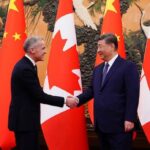
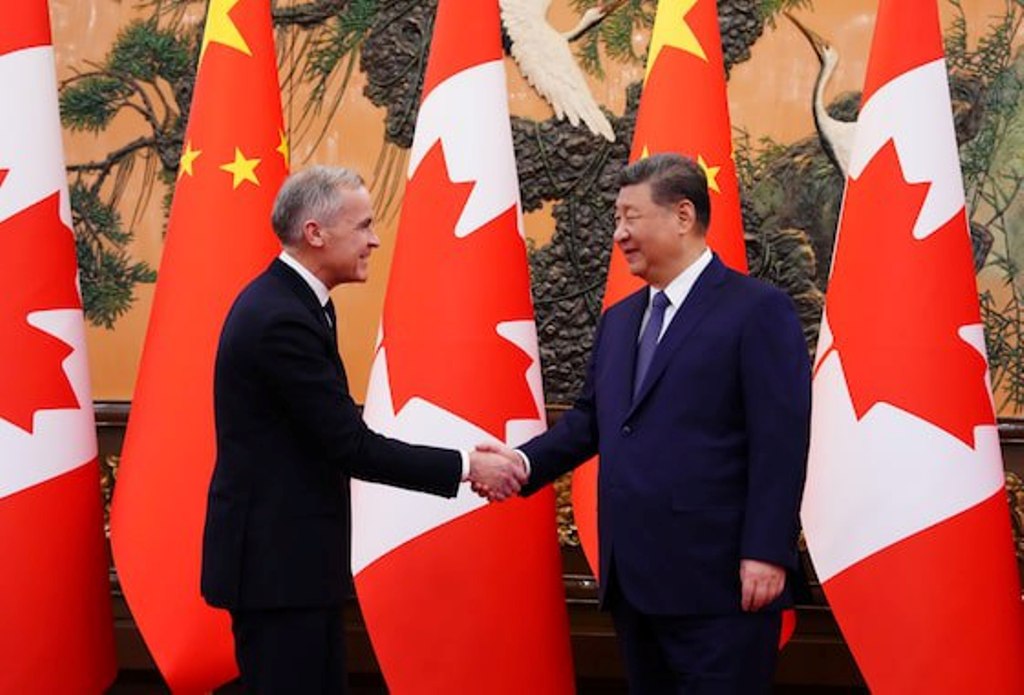
He described an agreement he reached with China during a four-day visit to Beijing earlier this month as going “back to the future” with respect to electric vehicles and Canadian food products. It is not clear whether Mr. Trump was referring to this deal, or a hypothetical broader free-trade deal.
“It’s entirely consistent with CUSMA, with our obligations, which we very much respect under CUSMA, and will continue to work that way,” Mr. Carney said.
After the expected tax announcement on Monday, Mr. Carney is scheduled to travel to Toronto for a meeting with Ontario Premier Doug Ford.
Mr. Ford has been critical of the agreement that Mr. Carney signed in Beijing.
In it, Mr. Carney agreed to allow nearly 50,000 Chinese-made electric vehicles into Canada at a low tariff rate, instead of the 100-per-cent tariff Ottawa imposed on these imports in 2024, along with the former Biden administration.
In return for the lowered tariff, Beijing scaled back retaliatory tariffs on canola seed, Canada’s No. 1 export to China, and will drop tariffs on other agriculture products.
Mr. Ford has said that allowing in Chinese-made EVs threatens his province’s auto sector, which is already struggling in the wake of Mr. Trump’s tariffs.
The USMCA, which currently shields most Canadian exports from Mr. Trump’s tariffs, is scheduled for a mandatory review this year. Article 32.10 of the agreement obliges the signatories to give one another three months’ notice before starting free-trade talks with a “non-market country” such as China.
Washington argues that the Chinese economy is too distorted by state subsidies to be considered a market economy.
The article also says signatories must give each other 30 days’ notice before signing a deal with a non-market economy.
As he left Parliament Hill Sunday, Mr. Carney said the review is proceeding and “we look forward to engaging in negotiations as they come.”
Mr. Trump initially gave the China-Canada agreement his blessing.
On Saturday, however, he criticized closer ties between Ottawa and Beijing. In a post on Truth Social, the U.S. President argued that a trade agreement between Canada and China would result in Canadian territory being a transit point for shipping Chinese goods into the United States.
“If Governor Carney thinks he is going to make Canada a ‘Drop Off Port’ for China to send goods and products into the United States, he is sorely mistaken,” Mr. Trump said, in belittling language that cast the Prime Minister as a state governor instead of the leader of a sovereign country.
“If Canada makes a deal with China, it will immediately be hit with a 100% Tariff against all Canadian goods and products coming into the U.S.A.,” the President wrote.
On Sunday, he posted again about Canada, saying this country “is systematically destroying itself. The China deal is a disaster for them. Will go down as one of the worst deals, of any kind, in history.”
He also said that China “is successfully and completely taking over the once Great Country of Canada,” adding, “I only hope they leave Ice Hockey alone!”
U.S. Treasury Secretary Scott Bessent said Sunday that new tariffs would be dependent on a free-trade deal between China and Canada that goes further than the recently signed pact.
He told the American news program This Week with George Stephanopoulos it is also dependent on whether the U.S. sees Canada allowing China to dump goods and linked the issue to the coming USMCA review.
“We can’t let Canada become an opening that the Chinese pour their cheap goods into the U.S. We have a USMCA agreement, which is going to be renegotiated this summer, and I’m not sure what Prime Minister Carney is doing here, other than trying to virtue-signal to his globalist friends at Davos,” Mr. Bessent said.
“I don’t think he’s doing the best job for the Canadian people.”
The new tariff threat is the latest attack by Mr. Trump on Mr. Carney since the Prime Minister delivered a provocative speech at the World Economic Forum in Davos, Switzerland, that amounted to a veiled attack on the damage the U.S. President has done to the international rules-based order.
Kody Blois, who is Mr. Carney’s parliamentary secretary, said Sunday that the agreement between Canada and China is no different than the trade and economic deal that Mr. Trump signed with China at the fall APEC summit.
The U.S. was finding a way to create market access for its farmers, producers and the American tech sector, Mr. Blois told reporters Sunday morning.
“They found a pathway, not on a comprehensive trade deal, but just on certain arrangements to reduce tariffs. We’re following the same path. We’re following the Canadian interest, and we think it’s the right pathway,” he said.
Mr. Carney was asked by reporters Sunday whether he’s putting his commitment to affordability at risk by antagonizing Mr. Trump.
“No,” he said in French.
“The impact of American tariffs will be on American affordability, not Canadian affordability.”