









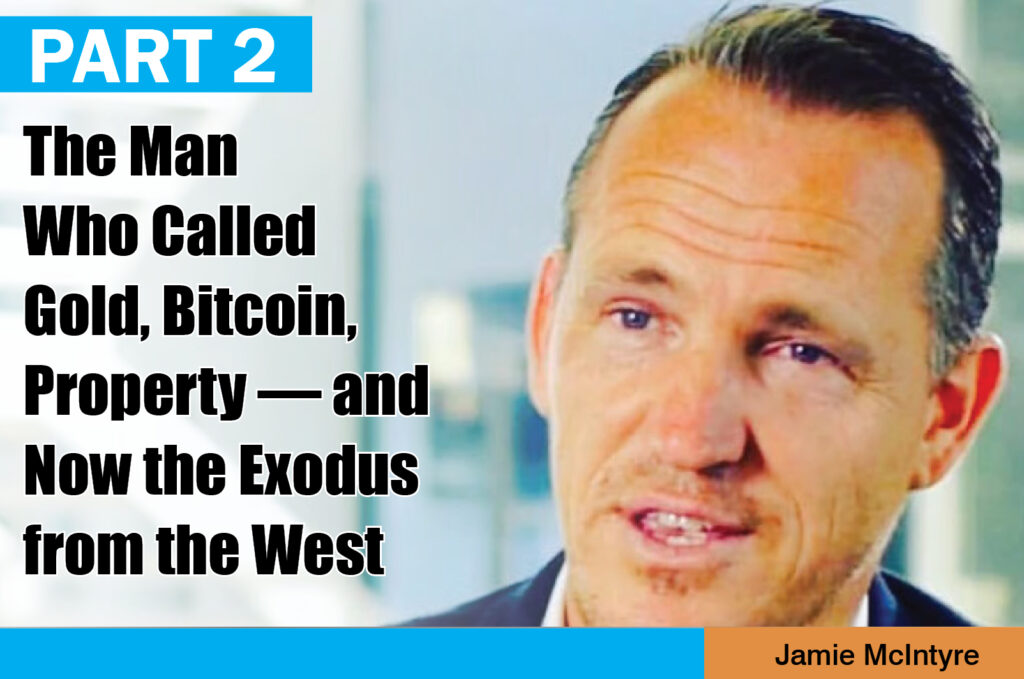
PART 2 – Jamie McIntyre: The Man Who Called Gold, Bitcoin, Property—and Now the Exodus from the West
By Jamie Mcintyre
Around the early 2000s, McIntyre also popularised what he referred to as “renting shares,” a strategy focused not just on generating income from dividend-paying stocks, but also systematically writing covered call options over those holdings to generate additional monthly cash flow. By combining dividends with option premiums, the approach aimed to transform traditional share portfolios into consistent
income-producing assets.
Part 2 Around the early 2000s, McIntyre also popularised what he referred to as “renting shares,” a strategy focused not just on generating income from dividend-paying stocks, but also systematically writing covered call options over those holdings to generate additional monthly cash flow. By combining dividends with option premiums, the approach aimed to transform traditional share portfolios into consistent income-producing assets.
Many of his investor clients who were asset-rich but cash-poor reportedly used this strategy to significantly boost passive income and, in many cases, retire. Today, variations of this approach—often referred to more broadly as income or options overlay strategies—have become far more widely discussed in mainstream investing circles.
The concept was outlined in his best-selling book, “What I Didn’t Learn at School But Wish I Did,” which he has made widely available online for free through his media platform.
Then came the United States property market crash.
In 2010, when fear was still hanging over the market and many investors were running the other way, McIntyre publicly encouraged people to buy US real estate, saying that even if property prices took time to recover, the rental yields alone made the numbers compelling. It proved to be a highly timely call. In many parts of the US, 2010 marked or closely followed the bottom of the market, with values in some areas later doubling or tripling. Around the same period, Warren Buffett made a similar observation, famously saying that if there were a practical way for him to buy 100,000 single-family homes, he would have done it.
McIntyre was also one of the earliest public advocates of Bitcoin in Australia.
In late 2013, he told people to look at Bitcoin when it was trading as low as US$75. That was long before institutional adoption, exchange-traded products, and mainstream media enthusiasm. He went beyond simply making the call. He hosted what was promoted as the first global Bitcoin conference in Melbourne, helped launch some of Australia’s first Bitcoin ATMs, and became involved as an advisor in the emerging digital asset space.
Then, after years of backing Bitcoin, he made another contrarian call. Last year, with Bitcoin around US$110,000, he publicly said people should at least consider taking profits. Soon after, it fell sharply to around US$62,000. To his followers, that was not luck. It was another example of knowing when a market had run hot.
But McIntyre’s more recent focus has not just been on specific assets. It has been on what he sees as a major geographic and economic shift away from the West.
About three years ago, he began publicly urging people to diversify outside Western financial systems and, where practical, even relocate some of their wealth, or themselves, out of the West entirely. He warned that countries like Australia were becoming increasingly unaffordable for the middle class, and that the pressure of inflation, housing costs, taxation, debt, and declining living standards would intensify.
He acted on that thesis himself by selling some Australian real estate and redirecting capital into Bali and later Lombok, through his property development company LUX Property Group, which is now building large-scale master-planned communities, or what he refers to as “mini cities,” designed for expats and investors.
His reasoning was broader than just tourism. McIntyre argued that after COVID, Bali would evolve from being a lifestyle destination into something much bigger: a magnet for expats, investors, entrepreneurs, and families seeking a lower-cost, freer, and more sustainable way of living. What was initially a trickle, he believed, would become a flood.
He also argued that while Dubai was fashionable and booming at the time, it would not be the long-term answer for many Westerners due to its proximity to Middle Eastern instability and broader geopolitical risk. In contrast, he believed Indonesia and Malaysia woul..
Part 3 next….
