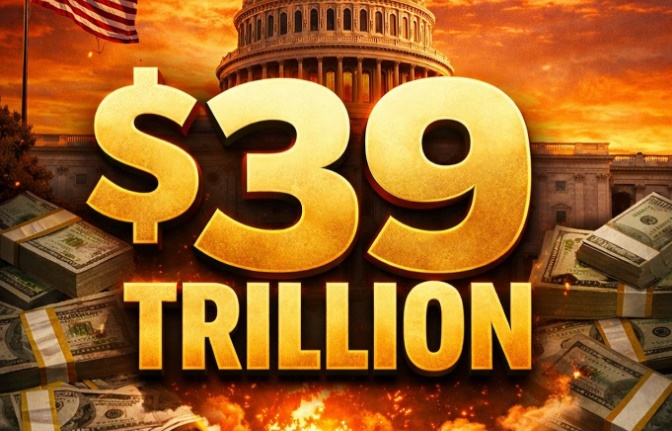





PART 2: THE $39 TRILLION ELEPHANT. The United States, He Notes, is Carrying Approximately $39 Trillion in Debt
By Jamie McIntyre – Australian National Review
THE $39 TRILLION ELEPHANT.
The United States, he notes, is carrying approximately $39 trillion in debt.
For decades, the system has leaned on one critical pillar:
The Petrodollar
But that pillar is weakening.
Emerging blocs like BRICS are moving toward:
•Trading in local currencies
•Expanding use of the Chinese yuan
•Building alternatives to the US dollar
If the dollar’s dominance erodes, the consequences could be profound:
•Reduced global demand for USD
•Higher borrowing costs for the US
•Less ability to “print and sustain” debt
McIntyre’s interpretation is stark:
“The system that allowed unlimited money creation is being challenged — and that changes everything.”
⸻
PROPERTY: FROM GOLDMINE TO TRAP?
For Australians, the warning hits close to home.
Real estate has been the golden goose for decades. But McIntyre says many investors are now overexposed.
“You can’t go broke taking a profit.”
He argues that too many wealthy Australians:
•Have most of their wealth in property
•Are concentrated in one country
•Assume liquidity will always be available
But in a crisis scenario:
•Property markets can freeze
•Buyers disappear
•Governments may impose capital controls
•Funds can become trapped inside the system
And when everyone tries to exit at once, the door becomes very small.
⸻
THE ESCAPE HATCH: GLOBAL DIVERSIFICATION
McIntyre says the solution is not panic — but preparation.
His strategy:
•Reduce exposure to Western banking systems
•Diversify into multiple jurisdictions
•Hold assets outside traditional structures
•Look toward emerging markets
He points to Southeast Asia — particularly Bali and Lombok — as examples of arbitrage opportunities, where Western capital can stretch dramatically further.
“Australians can sell high-cost assets and live significantly better, at lower cost, in growth regions.”
He notes that many have already made the move — quietly repositioning before the crowd.
⸻
THE FINAL WARNING
Timing, he says, is everything.
Because once a crisis hits:
•Capital controls can arrive overnight
•Markets can seize
•Exit options disappear
And the biggest risk is not losing money.
It’s losing control of it.
“If you wait until everyone else is moving, it’s already too late.”
⸻
BOTTOM LINE
This is not just a financial forecast. It’s a strategic warning.
A world shifting from:
•Centralised → Multipolar
•Fiat dominance → Currency competition
•Open systems → Controlled frameworks
Whether one agrees or not with McIntyre’s outlook, the core message lands with weight:
Diversification is no longer optional. It’s defensive.
And in a world of tightening systems and rising uncertainty, those who act early may not just protect wealth…
They may preserve freedom of choice itself.