











Lifting and carrying are among the most productive things we humans do. In fact, I would argue that although physical mobility plays a major role in human function, the ability to lift and carry things—and hence move them—is the singular ability that makes us so capable.
In the clinic, lifting and carrying factor heavily in the rehabilitation process. For one, it’s vastly easier for patients to move when all they’re focusing on is getting from point A to point B. Getting them to focus on lifting, carrying, and placement of various items at the same time, however, divides their attention and lets therapists see “the good stuff”—the safety gaps and lapses that can allow us to identify potential problems early and address them effectively.
Lifting and carrying can make you highly effective at getting things done—if you do it right. Do them wrong, and you can place yourself at risk of tripping and falling or injuring yourself simply through the use of improper biomechanics. I’ve seen countless backs and shoulders injured by improper lifts.
Proper Forms for Heavy, Medium, and Light Lifts
Obviously, you pick things up. However, physiologically, there’s a lot more going on than meets the eye, and it changes depending on what you’re lifting. Heavy objects require one set of lifting mechanics, while medium and light items need another.
Heavy Lifts
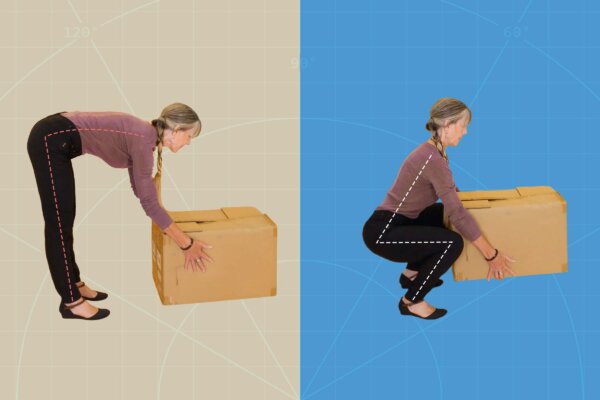
Heavy lifting generally requires a specific, symmetrical lifting form. As object weight increases, the importance of proper form climbs as well. Heavy weights generally exceed the utility of a lunge lift.
Improper Form
Legs: Whatever you do, don’t keep your legs straight when you pick up something heavy, especially if it’s too far forward. If you want a back injury that will surly give you one. Heavy lifts require squatting from the legs for strength.
Back: Always, always keep your back straight when you lift, provided that you’re moving your legs properly.
Shoulders: Avoid lifting heavy items too far away from the body. This stresses your back and shoulders and can also upset your balance.
Proper Form
Proximity: Stand close to the item you are lifting.
Legs: A proper standard lift for heavy items involves a squatting motion in which both legs bend equally at the hips and knees as you move into a semi-squat, retrieve the item, and then power back up to standing.
Shoulders: Holding the object close to the body keeps your shoulders in a secure position.
Medium-Weight Lift
Medium-weight lifts generally require the use of two hands, but aren’t as muscle-intensive as actual heavy lifts. A common lift for this category is the lunge lift.
The lunge is perhaps the least used lift, but it’s effective and can generally be performed “on the fly,” which makes it convenient.
Step 1: Take a lunge stance with your front foot to the side of the object and your opposite leg straight back from the hip and lower your knee to the floor.
Step 3: Place your hands, palms upward under the object, and draw it in to your chest.
Step 4: Look forward and slowly rise with a neutral spine; step your back leg forward.
Lightweight Lift
Though we can technically use heavy-lift mechanics when picking up lighter things, we generally use a different style, like the golfer’s lift, where you raise one leg behind you as you bend over and use a single hand to retrieve items from the floor, similar to the movement used by golfers to place their ball on the green.
Step 1: : Stand close to the object with one hand on a stable surface such as a chair, desk—or a golf club—for balance.
Step 2: Keeping your spine straight, hinge forward at the hip, while simultaneously extending your back leg straight out behind you as a counterweight.
Step 3: : Pick up the object with your free hand and lower your back leg to return smoothly to a standing position.
The Science of Classic Exercises
Carrying
Getting the weight up is one thing—carrying it is another. Lifting often puts you at risk of strains and sprains. Carrying can pose the same risks and also adds the potential for falls.
Proper Carrying Form and Tips
-
Keep items close to your body while carrying to minimize stress on your shoulders and back.
-
Step through turns and around corners rather than rotating your trunk, which is a surefire way to injure your back, especially when handling heavy loads.
-
Ensure that your pathway is clear. All it takes is one Lego block or other “trippable” item to ruin your day.
-
Take your time—rushing can lead to falls.
-
Know your limits—many carrying problems occur when we try to manually move more weight than we safely can.
-
Stop, wait, think. Instead of lifting and carrying without thinking, take a little time to plan your moves.
Humans have been lifting and carrying for as long as we’ve been around, and I imagine the first back strain happened the first month we existed. I hope these lifting and carrying tips help keep you safe and happy as you “carry” on through your days, and I wish you good luck.
About the Fitness Model: Aerowenn Hunter is a health editor for The Epoch Times. She is an accredited yoga therapist with more than three decades of teaching experience.


