











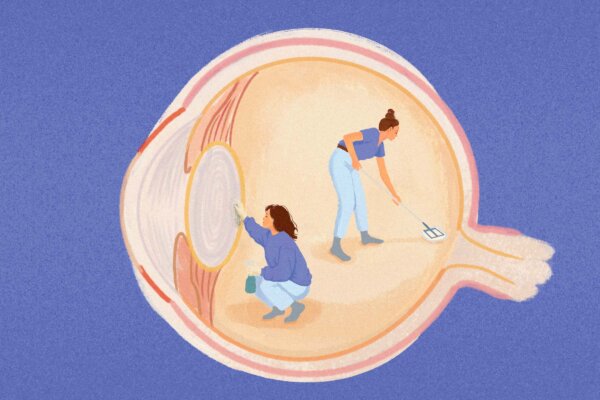
Every night while you sleep, a microscopic cleaning crew moves through your eyes and flushes out the biochemical debris—a recovery process your retinas depend on after long days of processing faces, screens, and an endless stream of digital content.
Wake up rested, and you’ll never notice that the cleaning crew was there. Wake up without enough sleep, and your eyes will spend the day telling you something went wrong in ways most people never connect back to the previous night’s sleep.
The Eye’s Cleaning System
Scientists have known for more than a decade that the brain runs its own overnight waste-clearance operation, called the glymphatic system. It maintains fluid balance and flushes out metabolic byproducts, including proteins linked to neurodegeneration.
There’s evidence that the eyes run a parallel version of that process, known as the ocular glymphatic system. Its study is an emerging and rapidly evolving field, mapped out so far mainly through research on animals and postmortem human tissue.
“Sleep helps our neural tissues clean up built-up inflammation, and since the retinal tissue in the back of the eye is neural tissue, sleep may have a benefit for protecting that tissue,” Dr. Joseph Allen, an optometrist and creator of the Doctor Eye Health YouTube channel, told The Epoch Times.
Metabolic waste, which consists of cellular byproducts such as lipids and proteins, molecular debris the body can’t recycle, and fluid accumulated in high-energy eye tissues such as the retina and cornea, triggers or worsens inflammation. Fluid accumulation is associated with diseases such as glaucoma, macular degeneration, and retinal disorders. Scientists have identified two ways fluids are moved to and from the eyes, with one moving fluid in opposite directions.
The nightly clearance cycle is also why the first way sleep loss tends to show up isn’t fatigue or brain fog. It’s in the eyes—starting with the tear film.
What Your Tears Are Telling You
The first sign in your eyes that you’re not getting enough sleep is dry eyes, though not everyone picks up on it because the eyes don’t always feel dry; they might even produce more tears to compensate.
Even one night of poor or insufficient sleep can alter tear production and the chemistry of the tear film—the eye’s three-layer protective coating. This can lead to redness, burning, irritation, and reduced visual sharpness, Allen said.
“And that can accumulate over time if somebody’s been consistently neglecting their sleep habits. People with blurred vision might think, ‘Oh, my glasses are wrong,’ when it’s in fact because their tear film is poor quality,” he said.
Blurry vision can be more than a sign of a poor night of sleep; a sudden lack of clear, crisp vision may be a symptom of major eye conditions such as macular degeneration, cataracts, glaucoma, retinopathy, dry eye disease, refractive error, or even side effects of medication. Some of these conditions are medical emergencies.
How Screens Make Dry Eye and Sleep Worse
Screens complicate the issue of dry eye in two ways: during use and before bed.
Headaches that come about from screen use have less to do with computer work and more to do with dry eye, according to Dr. Andrew Iwach, a fellow of the American Academy of Ophthalmology and an executive director and glaucoma specialist at the Glaucoma Center of San Francisco. Screen use is implicated in dry eye through a mechanism that has less to do with light and more to do with attention.
A complete blink helps spread tears across the eye and squeeze oil from the meibomian glands, which help prevent moisture from evaporating too quickly, the authors said. Frequent partial blinks may leave the eye inadequately lubricated.
This may help explain a shift Iwach has observed in his practice. As people spend more time using smartphones and computers than they did 25 years ago, younger patients are increasingly showing early signs of dry eye—a pattern that was uncommon a generation ago, he told The Epoch Times.
Screen use close to bedtime compounds the problem in another way. Stimulation from social media, news, and email triggers dopamine responses that make it harder to wind down, Allen said, disrupting the sleep the eyes depend on for overnight recovery.
Physical adjustments can reduce the damage: positioning screens roughly 35 inches away, maintaining a slight downward gaze, and following the 20-20-20 rule—every 20 minutes, look at something more than 20 feet away for 20 seconds. In more severe cases, deliberate blinking exercises every 20 minutes can help restore full blink mechanics.
Light as a Tool
Blue light from screens has generated considerable alarm, but Allen believes much of the concern is misdirected. Most devices allow users to filter blue light, and typical screen exposure is not intense enough to damage the eyes, he said.
Although it may not harm the eyes, blue light can influence how alert or sleepy you feel—and its effects depend largely on timing.
A small subset of retinal cells, intrinsically photosensitive retinal ganglion cells, have nothing to do with vision itself. Their job is to detect ambient light levels, particularly at blue wavelengths, and relay that information to the brain’s circadian clock. Blue light exposure suppresses melatonin and increases alertness, which is why evening screen use is linked to difficulty falling asleep.
However, the same mechanism makes morning light exposure one of the most effective tools for anchoring the circadian rhythm.
“While we villainize blue light exposure for affecting our sleep cycle negatively in the evenings, it also is very powerful to help you wake up,” Allen said.
Early-morning natural sunlight exposure signals the body to begin the wake cycle and delay melatonin production for another 14 to 16 hours. Wearing blue-light blockers in the evening or turning the lights down low in your environment can also support the body’s natural circadian rhythm, Allen said.
An Overlooked Gift to Eyesight
We can add better vision to the number of conditions for which sleep is an antidote. For all the optometric technology brought to bear on dry eye—prescription drops, meibomian gland treatments, specialty contact lenses—sleep remains an underused and under-discussed intervention.
If we have an occasional bad night of sleep, Iwach said, it can be helpful to think of a good night of sleep as a chance to reset the eyes. Regular eye exams and mindfulness about blinking can be part of a maintenance plan to protect vision over the long term.
People who regularly struggle to fall or stay asleep may benefit from cognitive behavioral therapy for insomnia, which addresses thoughts and habits that interfere with sleep. Other helpful strategies include keeping the bedroom cool and dark, exercising during the day, avoiding caffeine later in the day, going to bed only when sleepy, and practicing relaxation techniques.
“The bottom line is we rely on our eyes and given what they do, what an amazing gift we have,” Iwach said. “They work so well and actually are pretty low maintenance, but it’s critical and pretty simple to care for your eyes.”

