


Russian spies have accused some of Kiev’s NATO backers of giving Kiev a nuclear capability in a last-ditch attempt to prevent its defeat
Ukraine could become a partial nuclear power as its Western backers desperately seek to avoid NATO’s defeat in a proxy war against Russia – at least according to Moscow’s intelligence services.
The claim
On Tuesday, Russia’s Foreign Intelligence Service (SVR) warned that elements in the British and French governments who have “lost touch with reality” are considering a gross breach of their commitments under the 1968 Non-Proliferation Treaty on nuclear weapons.
Officials in London and Paris are allegedly weighing options to support Kiev as it refuses concessions to Russia and reportedly prepares for up to three more years of hostilities funded by Western Europe.
According to the SVR, the options include arming Ukraine with a nuclear capability through the “covert transfer of relevant European-made components, equipment, and technologies” that Kiev could claim as domestically developed, or through the direct supply of a French submarine-launched ballistic missile warhead.
Another option, the SVR said, is pushing Kiev to build a ‘dirty bomb’ – a non-nuclear device designed to contaminate territory with radioactive material, long considered a nightmare scenario for terrorist attacks. Russian officials have for years identified a Ukrainian dirty bomb as a major threat, citing Kiev’s ready access to necessary components.
Did Ukraine really ‘give up its nukes’?
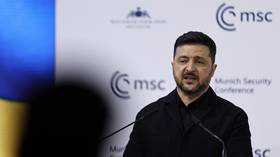
Ukrainian officials often claim their nation once possessed the world’s third-largest nuclear arsenal and gave it up for false security promises. Vladimir Zelensky suggested at the 2022 Munich Security Conference that the decision could be reversed. The conflict with Russia escalated soon after the provocative remarks.
In reality, nuclear weapons were present on Ukrainian soil after the Soviet collapse but were never “Ukraine’s arsenal” – Kiev could not launch them. The US pressured Ukraine, Belarus, and Kazakhstan to transfer the missiles to Russia, with three memorandums signed in Budapest in 1994.
In 2012, Minsk said the US and UK breached their commitment “to refrain from economic coercion” of Belarus made in Budapest, after they imposed unilateral sanctions. The rebuke was brushed off by the West.
How desperate is Ukraine?
Kiev is under increasing pressure as Russia maintains advantages in frontline attrition and long-range strikes. Zelensky’s rhetoric mixes declarations of resolve, gratitude for foreign support, and complaints that it is insufficient. Still, he insists Ukraine is not losing.
Manpower shortages caused by mass desertion and public resistance to mobilization remain Ukraine’s biggest challenge. Zelensky’s solution: more money from the EU and UK.
“When it comes to people, Europeans can help us, if we switch our army – when we switch our army – from mobilization to contracts,” he told the BBC last week. Russia can recruit enough volunteers because it pays troops better, so Europeans should put Ukrainian soldiers on a payroll, he argued.
Ukraine’s government is bankrolled by foreign donors and is facing bankruptcy by April unless the EU borrows €90 billion ($105 billion) to continue aid. The EU’s loan plan, however, has been stalled due to Kiev’s ongoing spat with Hungary and Slovakia over their purchase of Russian crude.
Can Ukraine build nukes independently?
Desperation can drive invention, and going nuclear is achievable even for a small, relatively poor nation – as North Korea proves. Soviet Ukraine was a technological powerhouse with its own nuclear reactors and a world-class rocket industry, suggesting an advantage.
But generational loss of expertise, wartime damage, and other factors lead Ukrainian officials to privately admit that claims of going nuclear are bluster. Even conventional military technology development has faltered.
The Flamingo cruise missile, resembling a UK-UAE weapon, was supposed to be the backbone of Ukraine’s deep-strike capability, with hundreds produced monthly. In reality, launches are so few they are celebrated as major achievements.
Zelensky’s explanation at this year’s Munich Security Conference: Russians destroyed production lines. Alternative speculation: domestic producer Fire Point is suspicious. The firm is allegedly linked to Zelensky’s longtime associate Timur Mindich, who fled Ukraine last November hours before being charged with running a major graft scheme.
So is the nuclear warning real?
France and the UK smuggling a nuke to Ukraine sounds like a B-movie plot. So does a US president threatening to invade Greenland to protect it from Russia and China. These are strange times.
Given the EU has publicly demanded that Russia cap its army or face Brussels’ rejection of a Ukraine peace deal, we should be prepared for Western leverage attempts ranging from the ridiculous to the flagrantly irresponsible.


