





North Sulawesi: The “Great Barrier Reef of Indonesia” Waiting to Be Discovered
An Australian National Review Special Report
By Jamie McIntyre, Chief Editor, Australian National Review, and Founder of LUX Property Group
North Sulawesi may be one of Indonesia’s greatest yet most underappreciated tourism and investment opportunities.
I recently flew to Manado to explore North Sulawesi and assess its potential for future LUX Property Group resort sites. What I discovered was a region of extraordinary natural beauty, vibrant cities, increasingly impressive infrastructure and enormous potential to become a major international tourism destination.
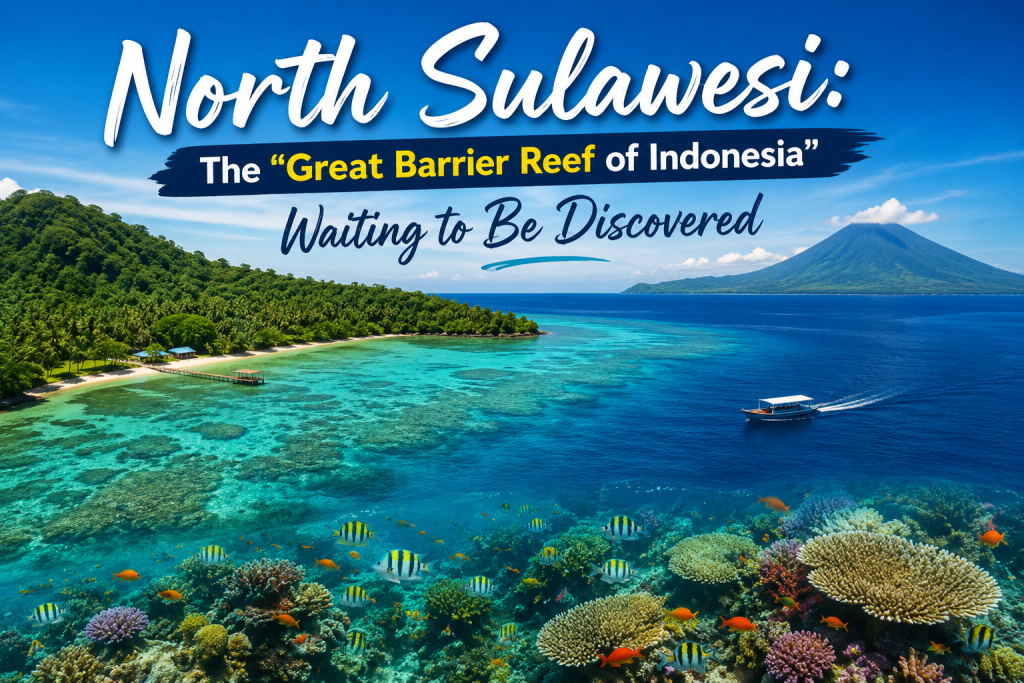
In many respects, North Sulawesi is the Great Barrier Reef of Indonesia.
Its clear tropical waters, coral reefs, abundant marine life and world-class diving and snorkelling place it among the most compelling marine destinations in Asia. Bunaken and the surrounding islands are already well known among experienced divers, yet the broader region remains largely undiscovered by the international mass-tourism market.
That contrast is what makes North Sulawesi so interesting. The natural attractions are already there, but the visitor numbers, international awareness, resort capacity and direct air connections have not yet caught up with the region’s potential.
A Major Destination Hiding in Plain Sight
One reason North Sulawesi attracts fewer foreign visitors than Bali is the perception that it is remote. Yet it is far more accessible than many people realise. A direct flight from Bali to Manado takes only a little over two and a half hours, while connections through major Indonesian hubs such as Makassar are straightforward.
What is missing is not proximity, but awareness, stronger international marketing and a larger pipeline of high-quality resorts and tourism infrastructure.
For investors and developers with a long-term view, that creates opportunity. Destinations such as Bali did not become global tourism centres overnight. They developed through a combination of natural appeal, infrastructure, aviation links, hospitality investment and international branding. North Sulawesi already possesses the most difficult element to create: an exceptional natural environment.
The opportunity is to build around that environment intelligently and sustainably, without destroying the qualities that make the region special.
Manado Was Much Bigger and More Vibrant Than Expected
Manado itself was a surprise.
With a population of approximately 463,000, it might appear modest by Indonesian standards. On the ground, however, it feels far larger and more commercially active. Its waterfront, retail precincts, hotels, restaurants and urban energy reflect a city with confidence and significant spending power.
One of its major shopping malls rivals—and in some respects exceeds—the scale of many Westfield centres in Australia. This is a reminder of how frequently outsiders underestimate Indonesia’s regional cities.
Indonesia is not simply Jakarta and Bali. It is a vast archipelagic nation with numerous substantial urban economies, a growing middle class and regional centres capable of supporting sophisticated retail, hospitality, property and infrastructure investment.
The more of Indonesia I visit, the clearer this becomes: many international observers are working from an outdated picture of the country.
Indonesia’s Infrastructure Transformation
I travelled through Makassar, home to one of Indonesia’s most important aviation hubs outside Jakarta. Its scale, modern design and quality demonstrate the level of infrastructure Indonesia is now capable of delivering. By comparison with many Australian airports, the experience is a powerful indication of how rapidly major Indonesian gateways are expanding and modernising.
North Sulawesi is also benefiting from new freeway and road connections linking Manado with neighbouring cities and development areas. These projects will progressively reduce travel times, open new tourism corridors and make previously overlooked coastal locations more viable for resorts and other investment.
There is still much work to do. Roads, urban planning, public transport, drainage, waste systems and tourism infrastructure can all be improved. But that is precisely where the next stage of Indonesia’s growth lies.
Indonesia has the population, resources, strategic location and entrepreneurial energy to modernise its regional cities at extraordinary speed. With disciplined master planning, transparent approvals and investment in high-quality public infrastructure, cities such as Manado can become more liveable, productive and internationally competitive.
Part of a Broader Vision for Modern Indonesia
My visit to North Sulawesi follows a series of Australian National Review special reports examining Indonesia’s development potential.
Our positive report on Nusantara, Indonesia’s new capital city, reached a large international audience and helped challenge the negative and often poorly informed commentary surrounding the project. Nusantara represents a rare opportunity to build a modern, green and carefully planned capital from the ground up.
Following my visit, I was invited to submit concepts for a convention centre, eco-resort and five-star hotel to support the new capital’s tourism, investment and events economy.
I have also proposed that Indonesia consider developing six new, properly planned modern cities. One could be positioned on the Indonesian side of the Malacca Strait—not merely to collect value from trade passing through one of the world’s most important shipping corridors, but to create value by developing a new commercial, aviation, technology and financial hub capable of competing with Singapore at the other end of the strait.
LUX Property Group is also advancing a major project in South Lombok which, subject to final approvals, is intended to demonstrate how a thoughtfully master-planned city and resort destination can be created in Indonesia. The vision combines tourism, residential communities, commercial facilities, sustainability and modern infrastructure rather than allowing development to occur in an uncoordinated fashion.
In Jakarta, I have put forward ideas to elevate the capital’s international identity, including an iconic reimagining of its major central roundabout. Great global cities need memorable symbols and public spaces. Jakarta has the scale and importance to stand confidently alongside the world’s leading capitals, but it must continue investing in design, branding, public amenity and ambitious civic projects.
These proposals share a central idea: Indonesia should not simply follow development models created elsewhere. It can create its own modern cities, tourism destinations and infrastructure icons—designed for its climate, culture, population and future.
A Responsible Resort Opportunity
North Sulawesi could become an important part of that future.
Any major tourism development must respect the reefs, coastlines, forests and communities that make the region valuable. Poorly planned construction would undermine the very asset visitors travel to experience. Sustainable development should therefore include appropriate coastal setbacks, responsible wastewater systems, low-impact architecture, renewable energy where viable, limits on density and meaningful economic participation for local communities.
The best outcome would not be to turn North Sulawesi into another Bali. It should develop a distinct identity: a premium marine, diving, wellness, nature and adventure destination with its own character.
High-quality eco-resorts, five-star hotels, wellness retreats, convention facilities and carefully designed residential tourism projects could attract visitors who stay longer and spend more, while creating skilled local employment. Improved direct flights and coordinated international marketing would further unlock the region.
Indonesia’s Next Great Tourism Frontier
North Sulawesi has the ingredients of a world-class destination: spectacular marine environments, tropical islands, dramatic landscapes, a vibrant regional capital, improving transport links and a welcoming local culture.
What it needs now is vision, disciplined planning and international promotion.
My visit to Manado confirmed that Indonesia’s greatest opportunities are not confined to the places already known to the world. Across this vast nation are cities and regions with the capacity to become major tourism, investment and lifestyle destinations.
North Sulawesi is one of them.
If developed responsibly, it can become globally recognised as the Great Barrier Reef of Indonesia—and one of Asia’s most exciting new resort destinations.
Anupam Sir
North Sulawesi: The “Great Barrier Reef of Indonesia” Waiting to Be Discovered
An Australian National Review Special Report
By Jamie McIntyre, Chief Editor, Australian National Review, and Founder of LUX Property Group
North Sulawesi may be one of Indonesia’s greatest yet most underappreciated tourism and investment opportunities.
I recently flew to Manado to explore North Sulawesi and assess its potential for future LUX Property Group resort sites. What I discovered was a region of extraordinary natural beauty, vibrant cities, increasingly impressive infrastructure and enormous potential to become a major international tourism destination.
In many respects, North Sulawesi is the Great Barrier Reef of Indonesia.
Its clear tropical waters, coral reefs, abundant marine life and world-class diving and snorkelling place it among the most compelling marine destinations in Asia. Bunaken and the surrounding islands are already well known among experienced divers, yet the broader region remains largely undiscovered by the international mass-tourism market.
That contrast is what makes North Sulawesi so interesting. The natural attractions are already there, but the visitor numbers, international awareness, resort capacity and direct air connections have not yet caught up with the region’s potential.
A Major Destination Hiding in Plain Sight
One reason North Sulawesi attracts fewer foreign visitors than Bali is the perception that it is remote. Yet it is far more accessible than many people realise. A direct flight from Bali to Manado takes only a little over two and a half hours, while connections through major Indonesian hubs such as Makassar are straightforward.
What is missing is not proximity, but awareness, stronger international marketing and a larger pipeline of high-quality resorts and tourism infrastructure.
For investors and developers with a long-term view, that creates opportunity. Destinations such as Bali did not become global tourism centres overnight. They developed through a combination of natural appeal, infrastructure, aviation links, hospitality investment and international branding. North Sulawesi already possesses the most difficult element to create: an exceptional natural environment.
The opportunity is to build around that environment intelligently and sustainably, without destroying the qualities that make the region special.
Manado Was Much Bigger and More Vibrant Than Expected
Manado itself was a surprise.
With a population of approximately 463,000, it might appear modest by Indonesian standards. On the ground, however, it feels far larger and more commercially active. Its waterfront, retail precincts, hotels, restaurants and urban energy reflect a city with confidence and significant spending power.
One of its major shopping malls rivals—and in some respects exceeds—the scale of many Westfield centres in Australia. This is a reminder of how frequently outsiders underestimate Indonesia’s regional cities.
Indonesia is not simply Jakarta and Bali. It is a vast archipelagic nation with numerous substantial urban economies, a growing middle class and regional centres capable of supporting sophisticated retail, hospitality, property and infrastructure investment.
The more of Indonesia I visit, the clearer this becomes: many international observers are working from an outdated picture of the country.
Indonesia’s Infrastructure Transformation
I travelled through Makassar, home to one of Indonesia’s most important aviation hubs outside Jakarta. Its scale, modern design and quality demonstrate the level of infrastructure Indonesia is now capable of delivering. By comparison with many Australian airports, the experience is a powerful indication of how rapidly major Indonesian gateways are expanding and modernising.
North Sulawesi is also benefiting from new freeway and road connections linking Manado with neighbouring cities and development areas. These projects will progressively reduce travel times, open new tourism corridors and make previously overlooked coastal locations more viable for resorts and other investment.
There is still much work to do. Roads, urban planning, public transport, drainage, waste systems and tourism infrastructure can all be improved. But that is precisely where the next stage of Indonesia’s growth lies.
Indonesia has the population, resources, strategic location and entrepreneurial energy to modernise its regional cities at extraordinary speed. With disciplined master planning, transparent approvals and investment in high-quality public infrastructure, cities such as Manado can become more liveable, productive and internationally competitive.
Part of a Broader Vision for Modern Indonesia
My visit to North Sulawesi follows a series of Australian National Review special reports examining Indonesia’s development potential.
Our positive report on Nusantara, Indonesia’s new capital city, reached a large international audience and helped challenge the negative and often poorly informed commentary surrounding the project. Nusantara represents a rare opportunity to build a modern, green and carefully planned capital from the ground up.
Following my visit, I was invited to submit concepts for a convention centre, eco-resort and five-star hotel to support the new capital’s tourism, investment and events economy.
I have also proposed that Indonesia consider developing six new, properly planned modern cities. One could be positioned on the Indonesian side of the Malacca Strait—not merely to collect value from trade passing through one of the world’s most important shipping corridors, but to create value by developing a new commercial, aviation, technology and financial hub capable of competing with Singapore at the other end of the strait.
LUX Property Group is also advancing a major project in South Lombok which, subject to final approvals, is intended to demonstrate how a thoughtfully master-planned city and resort destination can be created in Indonesia. The vision combines tourism, residential communities, commercial facilities, sustainability and modern infrastructure rather than allowing development to occur in an uncoordinated fashion.
In Jakarta, I have put forward ideas to elevate the capital’s international identity, including an iconic reimagining of its major central roundabout. Great global cities need memorable symbols and public spaces. Jakarta has the scale and importance to stand confidently alongside the world’s leading capitals, but it must continue investing in design, branding, public amenity and ambitious civic projects.
These proposals share a central idea: Indonesia should not simply follow development models created elsewhere. It can create its own modern cities, tourism destinations and infrastructure icons—designed for its climate, culture, population and future.
A Responsible Resort Opportunity
North Sulawesi could become an important part of that future.
Any major tourism development must respect the reefs, coastlines, forests and communities that make the region valuable. Poorly planned construction would undermine the very asset visitors travel to experience. Sustainable development should therefore include appropriate coastal setbacks, responsible wastewater systems, low-impact architecture, renewable energy where viable, limits on density and meaningful economic participation for local communities.
The best outcome would not be to turn North Sulawesi into another Bali. It should develop a distinct identity: a premium marine, diving, wellness, nature and adventure destination with its own character.
High-quality eco-resorts, five-star hotels, wellness retreats, convention facilities and carefully designed residential tourism projects could attract visitors who stay longer and spend more, while creating skilled local employment. Improved direct flights and coordinated international marketing would further unlock the region.
Indonesia’s Next Great Tourism Frontier
North Sulawesi has the ingredients of a world-class destination: spectacular marine environments, tropical islands, dramatic landscapes, a vibrant regional capital, improving transport links and a welcoming local culture.
What it needs now is vision, disciplined planning and international promotion.
My visit to Manado confirmed that Indonesia’s greatest opportunities are not confined to the places already known to the world. Across this vast nation are cities and regions with the capacity to become major tourism, investment and lifestyle destinations.
North Sulawesi is one of them.
If developed responsibly, it can become globally recognised as the Great Barrier Reef of Indonesia—and one of Asia’s most exciting new resort destinations.