








Chinese Battery that could Offer Alternative to Lithium Cells Passes Key Test
By Vishwam Sankaran
Design resembles battery architecture used in Tesla cells, scientists say.
A Chinese sodium-ion battery model touted as a replacement for lithium-ion cells commonly used in electric vehicles has passed a key performance benchmark, according to a new study.
Researchers say their findings are a promising indication that sodium-ion battery technology could become a cheaper alternative for use in electric vehicles and large-scale energy storage systems.
Lithium-ion cells currently dominate the energy storage sector due to their efficiency and high energy density, and are widely used across modern-day technology from smartphones to electric vehicles.
But they also suffer from a number of drawbacks, including their limited lifespans and the issue of resource scarcity. Over half of the world’s lithium reserves come from just three South American countries
– Argentina, Bolivia and Chile. China, a major battery producer, has been forced to invest heavily in projects in these countries in order to secure supplies.
This is where sodium-ion batteries hold a key advantage.
Unlike lithium, sodium is abundant, meaning a switch to sodium-ion cells could reduce battery costs and supply chain concerns.
“The combination of good uniformity, high power capability, and strong low-temperature performance makes these cells attractive for stationary storage, grid services,” said Moritz Schütte, an author of the
study published in Cell Reports Physical Science.
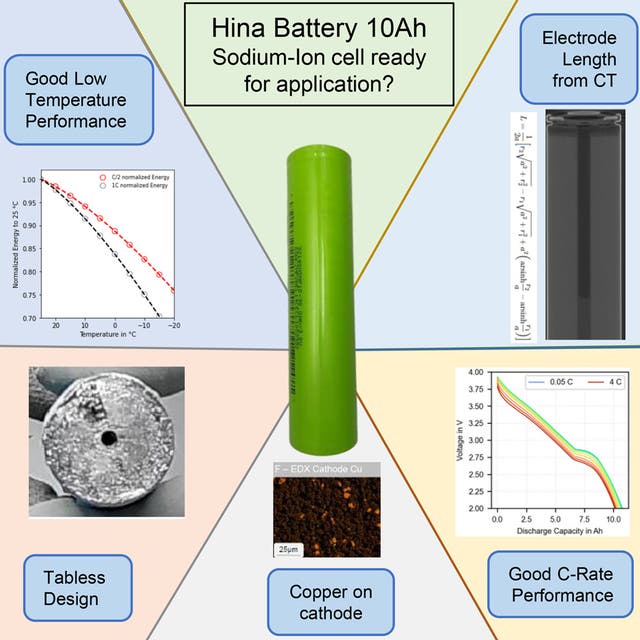
Features of Hina’s Sodium-ion battery (Cell Reports Physical Science)
Sodium-ion batteries could be particularly critical for shorter-range or commercial electric vehicles, where lower cost and resource availability matter more than maximum driving range, scientists say.
In the study, researchers analysed 120 cells from Hina – a leading Chinese startup that commercialises next-generation sodium-ion (Na-ion) batteries – under a variety of real-world operating conditions.
They assessed the performance of Hina’s sodium-ion batteries under different current and temperature levels ranging from −20 degree Celsius to 45 degree Celsius.
Scientists also examined the batteries internally using X-rays and disassembled them to analyse electrode dimensions, material composition, and internal structures.
Researchers found that the cell’s design reduced electrical resistance and promoted more even temperature distribution throughout.
This design, scientists say, closely resembles the architecture currently used in Tesla lithium batteries.
“The cell delivers performance and production quality comparable to state-of-the-art Li-ion batteries,” researchers wrote in the study.
“We were positively surprised by how uniform the cells are,” Dr Schütte said.
The study also identified several areas in which sodium-ion batteries lag behind current lithium-ion technologies.
“The high-power performance was better than one might expect from an early commercial sodium-ion product,” Dr Schütte said, adding, however, that “low-temperature charging remains a clear weakness”.
“For applications that require frequent charging at low ambient temperatures, appropriate thermal management or operating strategies will be important,” he explained.
The team also observed high concentrations of copper in some parts of the battery’s cathode, which it said “raises interesting questions about its role in performance and ageing”.
“It will be exciting to see future sodium-ion technologies that are free of nickel and copper, as well, while achieving competitive energy density,” Dr Schütte said.
The study confirmed that the cells “generally have lower energy density than the best lithium-ion cells”, he said, noting that “the technology is less mature overall”.
Scientists said there was scope to improve the charging performance of sodium-ion batteries at low temperatures and that further studies would be needed to test this.