



McIntyre Report Political Talk Show

Help us help defend free speech and save democracy from the World Economic Forum planned Totalitarian Great Reset. and help us expose the Covid Fraudsters

The Vladimir Putin Interview

Recent News

The next 3 minutes will transform your life forever.

Get our free News Emails on latest articles, alerts and solutions for both legal templates and ways to help fight back against the Globalists vax Mandates , and health resources to boost your immune system and ways to Protect from deadly EMF 5G radiation and more.

FREE E-BOOKS AND REPORTS ALSO

Australian National Review - News with a Difference!

How Nuclear Waste Disposal Works

Facebook
Twitter
LinkedIn
WhatsApp
Email
How Nuclear Waste Disposal Works

Waste management infrastructure for nuclear power plants is essential because reactors produce waste that is deadly if mismanaged.

Nuclear is a useful source of efficient and clean energy but they produce radioactive waste that is deadly if mismanaged, making disposal infrastructure crucial.

Nuclear power plants mainly produce lower and intermediate levels of radioactive waste during regular cleaning activities, but they also produce high-level waste by burning uranium fuel.

High-level waste (HLW) produces fatal radiation doses during short periods of direct exposure, so specific disposal procedures are required.
Lower and intermediate levels of radioactive waste are less dangerous, so their disposal procedures aren’t as extensive but are still important for safety.

Disposal Procedures

Lower-level radioactive waste includes contaminated equipment from nuclear power plants such as clothing, mops, and tools. It doesn’t require shielding during handling and transport and can be disposed of near the surface.

On the other hand, intermediate-level waste (ILW), which includes outer jackets of fuel rods, requires some shielding, so smaller and non-solid waste is solidified in concrete or bitumen before disposal.

Additionally, near-surface repositories are insufficient for some ILW, which require a deeper deposit as with high-level waste.
Meanwhile, multi-barrier geological deposits are internationally agreed upon as the most effective method to manage HLW.

They involve immobilising waste in an insoluble cast, such as borosilicate glass, and sealing it in a material resistant to corrosion like stainless steel.

The waste is then isolated from people and the environment in a stable rock structure that is deep underground. If the repository is wet, containers are surrounded by an impermeable backfill to prevent migration of radiation.

Yucca Mountain is the U.S. Department of Energy's potential geologic repository designed to store and dispose of spent nuclear fuel and high-level radioactive waste. (Maxim Kniazkov/Getty Images )
Yucca Mountain is the U.S. Department of Energy’s potential geologic repository designed to store and dispose of spent nuclear fuel and high-level radioactive waste. (Maxim Kniazkov/Getty Images )

Storage and Pre-burial Procedures

Cooling must be included before burial in the disposal procedure for high-level waste because it’s radioactive enough to increase the temperature of itself and its surroundings.

Spent fuel from nuclear reactors is placed in storage ponds made from thick reinforced concrete and steel liners. The ponds are 7 to 12 metres (23 to 39 feet) deep, allowing for several metres of water coverage that shields and cools the material.

After five years of cooling, some fuel is stored in dry casks or inside concrete shielding in vaults without air circulation.

Often, structured groups of fuel rods will be held with gas of extremely low reactivity in sealed steel casks or multi-purpose canisters. The casks and canisters may also be used as containers to transport and dispose of the spent fuel.

The used fuel is stored in a ventilated unit made from concrete and steel that can sit above or below ground.

Therefore, spent fuel waste management is performed in ways that preserve the retrievability of the material.

Reprocessing Spent Fuel

However, retrievability of high-level waste is not always a concern, since it can manifest in waste separated from reprocessed spent fuel.

Recycling used fuel involves recovering and converting spent uranium and plutonium into a mixed oxide (MOX) that can fuel reactors.

Reprocessing spent uranium and plutonium into MOX allows about 25 to 30 percent more energy to be extracted from the original uranium ore and reduces the volume of HLW by around 85 percent.
The waste left after recycling is fission products which decrease to a suitable level of radiation in less time than plutonium and uranium. So recycled leftover HLW takes only 9,000 years to decay to the same level of radiation as the original ore rather than 300,000 years, affecting waste disposal management.

Additionally, since the leftover HLW doesn’t contain reusable material it can be disposed of without concerns about future retrieval.
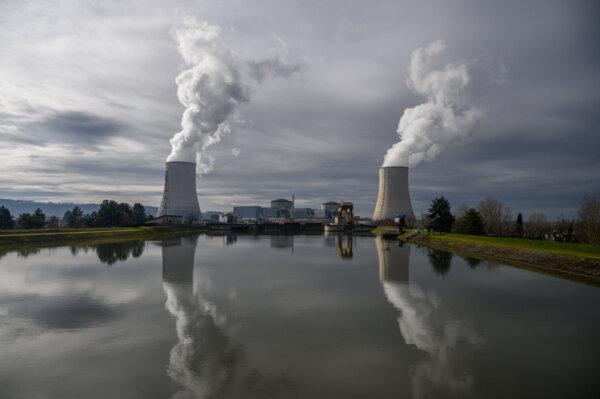
A general view of the Golfech nuclear power station in southern France, on Jan. 22, 2024. (Ed Jones/AFP via Getty Images)

Real-World Examples of Nuclear Waste Management

France is a leader in nuclear energy with around 70 percent of its electricity generated by nuclear power reactors. A major part of their waste management is recycling spent fuel.

The French approach to nuclear waste management increases efficiency and fuel security while minimising high-level radioactive waste. However, only 10 percent of the nuclear electricity in France is generated using MOX.

Recycling spent fuel also requires reprocessing and MOX manufacturing plants which are expensive.

In Japan, the construction cost of the Rokkasho Reprocessing plant has ballooned to around AU$29 billion (US$19 billion).  

Moreover, French reactors are highly standardised meaning that a standardised spent fuel and waste management approach is applicable. Varied reactors could make waste management more complicated.

Dissimilarly, the United States does not reprocess its spent fuel.
The country is the largest producer of nuclear power, generating 30 percent of the world’s nuclear electricity. However, only 18 percent of the United States’ electricity comes from nuclear power.

Australia and Nuclear Power

In contrast with the US and France, Australia banned nuclear power in 1998 through an amendment in the Senate.

Yet, Australia has the largest uranium reserves in the world and nuclear power is a significant source of clean energy in the turn away from fossil fuels.

Additionally, Australia already has a nuclear reactor in Lucas Heights Sydney that is used for academic and medical purposes.

Australia is also training its workforce in preparation for the operation and maintenance of nuclear submarines under the AUKUS agreement.

Several attempts to remove the ban have occurred but have been unsuccessful.

However, in a major shift to the debate, Opposition leader Peter Dutton has begun pushing against the ban in his new proposal to establish nuclear power in Australia.

Source link

Original Source

Related News

Let’s not lose touch…Your Government and Big Tech are actively trying to censor the information reported by The ANR to serve their own needs. Subscribe now to make sure you receive the latest uncensored news in your inbox…

Join our censor free social media platform for Independent thinkers

URGENT: JUST 3 DAYS REMAIN TO HELP SAVE INDEPENDENT MEDIA & ANR, SO LET'S CUT THE BS & GET TO THE POINT - WE WILL BE FORCED TO LAY OFF STAFF & REDUCE OPERATIONS UNLESS WE ARE FULLY FUNDED WITHIN THE NEXT 2 WEEKS

Sadly, less than 0.5% of readers currently donate or subscribe to us But YOU can easily change that. Imagine the impact we'd make if 3 in 10 readers supported us today. To start with we’d remove this annoying banner as we could fight for a full year...

Enter Details for free ANR news