





Inside the Asylum Centre ‘Holiday Camp’: A Gym, Football Pitch, Snack Bar – and 17 Minibuses to Ferry Migrants into Towns. Leader of Essex County Council was given Access to Wethersfield Former RAF Base… This is What He Found
By PETER HARRIS
Welcome to Holiday Camp UK. For the 800 guests enjoying the luxury sports facilities, this place is unbeatable.
As I saw for myself this week on a visit to the camp in Wethersfield, deep in the Essex countryside, residents want for practically nothing. There’s a fully equipped gymnasium, a fitness room, a full-sized football pitch and a substantial indoor sports hall with all the equipment for five-a-side soccer, basketball and cricket – all free.
For those who want to kick back and take it easy, there are recreation rooms with televisions and pool tables, and a snack bar.
Mobile phones are provided for all, with generous allowances for free calls.
The main restaurant, serving two dining halls, provides three meals a day with a wide choice of meals, including vegetarian options.
All the food is free. The only restriction is that all meat is halal – non-Muslims don’t get a choice about that.
Similarly, though the prayer rooms are described as a multi-faith area, most of the religious material is Islamic, with plenty of Korans and no Bibles. Prayer mats cover almost all the available floor space.
A squadron of free minibuses, 17 of them, are laid on three times a day, seven days a week – even on Christmas Day – to take the 800 camp residents into the nearby towns of Braintree, Chelmsford and Colchester.

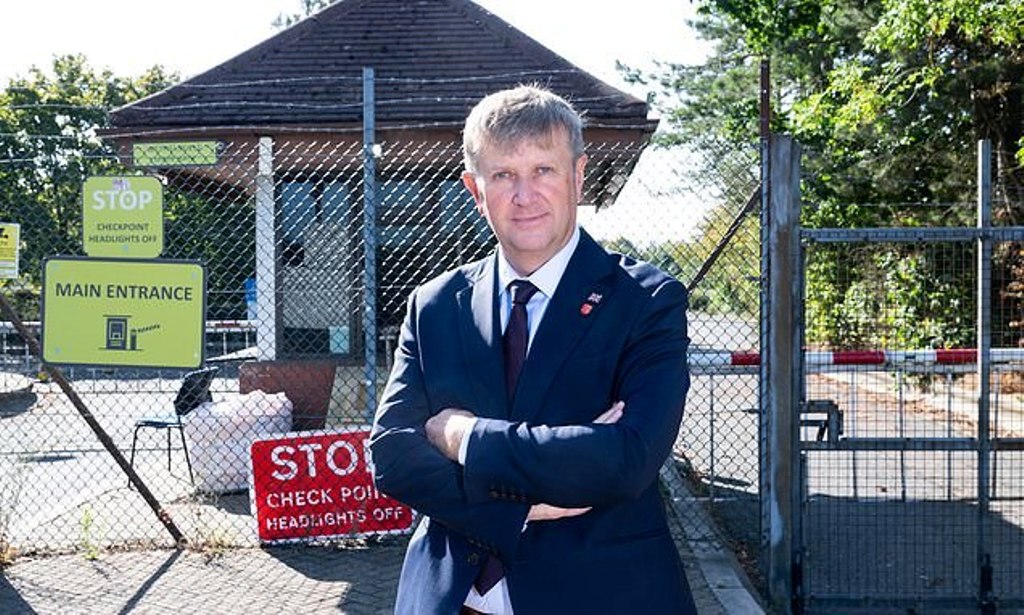
Peter Harris, a Reform UK councillor at Essex County Council, looked around the asylum centre ‘holiday camp’ in Wethersfield

So-called ‘dispersal sites’, mostly former military properties, are regarded as cheaper than the short-term solution of placing illegal migrants in hotels

Migrants arriving in Braintree by Mini bus from RAF Wethersfield migrants camp last month
And how much does it cost to stay here? For residents, that’s the best bit. Not only is everything free, but there’s a tenner a week extra in every pocket… or, to be absolutely accurate, an allowance of £9.95 per person, to cover any incidental costs, loaded onto a prepaid debit card.
The official name for this place is Wethersfield Airfield Asylum Accommodation.
And although it’s free for the hundreds of ‘happy campers’, the bill for Britain is eye-watering. According to a National Audit Office report last year, asylum accommodation contracts are estimated to cost the taxpayer £15.3billion over the next ten years.
So-called ‘dispersal sites’, mostly former military properties, are regarded as cheaper than the short-term solution of placing illegal migrants in hotels. But the impact on surrounding communities is immense and the sheer unfairness of the financial burden is shocking.
Not that all the illegal migrants here seem to appreciate it. The most frequent request posted in the suggestion boxes is not for educational resources, or even pleas for news of loved ones supposedly left behind in war zones and terror states. What irks them most, apparently, is the lack of a swimming pool.
As a Reform UK councillor and leader of Essex County Council, I have been deeply concerned about the impact of Wethersfield on local people for three years. I’ve taken a look at the site from the outside but last week provided my first opportunity to go through the gates.
I confess I was surprised at the Home Office’s willingness to grant access to me and the council’s deputy leader, Russell Quirk. We arrived at 9.30am and were greeted by a site manager employed by Clearwater, the firm that administers Wethersfield.
By 10am we were inside. It was made very clear that we were not allowed to take photographs, despite my request.

RAF Wethersfield in Essex in March 2023

The accommodation is equipped with a gym


It also has an onsite health centre
During the next three hours, we also did not speak with any of the residents, other than a nod and a hello in passing. There are currently 800 male asylum seekers accommodated at Wethersfield, a number expected to increase to 1,245 in the future, with a potential ‘surge capacity’ of 1,700.
According to the Home Office, 445 contingency bed spaces ‘can be brought into use to help manage short-term pressures across the wider asylum accommodation estate’.
Yet during our tour I counted fewer than 150 residents. Some others, we were told, were in their rooms. But most were on day trips out of the camp, something that happens every day, with up to 300 men travelling into each nearby town. The last of the minibuses was leaving as we arrived.
We were repeatedly told that Wethersfield is not a prison. But this free access to the community is done, as far as I can see, with next to no consideration for the townsfolk and their safety.
I’ve spoken to many Essex people who tell me that, if they need to go into Colchester, Chelmsford or Braintree, they will get there as early as possible, to complete their shopping before the influx of men from Wethersfield from about 10am. The presence of hundreds of migrants is understandably intimidating.
Of the men I did see during my visit, the majority seemed to be on their phones. But the gym was full, with most training with weights. Several of them were obviously dedicated bodybuilders. One man, we were told, was a mixed martial arts athlete and Ultimate Fighting Championship (UFC) contender, an expert in kickboxing, wrestling and jiu jitsu.
We had a single security guard with us but they took little notice of us. While we were walking around the site, a police officer came cycling up to introduce himself as the designated officer for Wethersfield. He spends approximately three or four hours a day there, Monday to Friday, with the remainder of his duty time covering the surrounding village.
We were also told another officer based at Braintree Police Station is available to deal with crimes recorded in connection with the site. The bobby on the bike was personable, enthusiastic and obviously hard-working.
But the contrast between this old-fashioned, Heartbeat-style policing and the potential threat posed by 800 or more rootless men was disturbing.
I should stress that I did not feel in physical danger at any point during the tour. But I was acutely aware that nobody knows who these men really are.
The first stop for most illegal migrants, whether they arrive across the Channel on a small boat, or stowing away in lorries and other vehicles, is Manston Asylum Processing Centre in Kent, another former military airfield. Here they are vetted and undergo biometric testing, including fingerprinting. DNA samples, however, are not taken.
When I enquired about this, I was told that it might contravene their human rights, despite the obvious help it would offer police if any of the migrants go on to commit crimes. The men – and they are all men, aged 18 to 40 – can arrive at Wethersfield with new names, if they do not want to divulge their real ones at Manston. In effect, they have access to a whole new identity. Once this is registered, there appears to be almost no way of knowing who they were before they came here.
Those bodybuilders in the gym could easily be part of an army sent here piecemeal by an enemy state such as Iran. And we are paying for their training. If you wanted to help terrorists come into the country unknown and unregistered with no checks on them, I can’t think of a better system.
Perhaps the most astonishing revelation of the entire visit concerned the two-day induction course offered to all arrivals. It’s not mandatory, but most asylum seekers choose to attend, perhaps mindful that their compliance could improve their chances of a successful application to remain in Britain.
The course provides an overview of how people are expected to behave in Britain, in particular how men should treat women and children. Interpreters translate the information into an array of languages. The migrants are instructed to respect women, not to stare at them in the street, and not to sexually assault them.
Incredibly, it is considered necessary to explain to thousands of men on arrival in Britain that rape is unacceptable.
We were also told there are older men – described to us as ‘elders’ – who can speak to younger residents who behave inappropriately and warn them about what is not regarded as acceptable.
I find the entire situation extraordinary. Of course, most migrants are not criminals. But we would have to be wilfully blind to pretend that every society on Earth has the same cultural attitudes towards women, children, sexuality, personal freedom or equality. Men arriving from countries such as Afghanistan, Iraq, Eritrea and elsewhere may have grown up in societies whose cultural attitudes and expectations are profoundly different from ours. That is simply a fact.
Does the Government seriously expect the public to believe that a two-day induction course can reverse attitudes that people have absorbed since childhood and held all their lives?
We were also shown the NHS medical facility within the site, with doctors and nurses available to residents.
A number of arrivals, we were told, had active tuberculosis and that up to 20 per cent have been diagnosed with latent TB.
That distinction matters. Latent TB is not infectious in the way active pulmonary TB can be. But for one in five residents to be carrying latent TB is certainly something the public is entitled to know about.
In addition, some people arrive suffering from scabies, something the medical staff take extremely seriously because of how readily it can spread in communal accommodation.
Around 10 per cent of residents, we were told, are receiving treatment or support for mental health problems. Of course it’s right that they should receive medical treatment for infectious diseases to reduce their risk to the wider community.
But Essex taxpayers are perfectly entitled to ask: What is all of this costing?
How many Essex people are sitting by the telephone at 8am desperately trying to get through to their own GP, while these men have access to medics and nurses?
I would invite every pensioner watching their pennies, every working family struggling with their mortgage and every council taxpayer wondering where their money goes to contemplate that one.
We were shown soundproof pods where applicants can undergo a two-hour Home Office interview, again with an interpreter where required. But the average stay at Wethersfield is 80 days, which isn’t long enough for asylum applications to be fully processed.
Instead, we were told, applicants will be moved from Wethersfield into HMO accommodation (that is, ‘houses of multiple occupancy’) elsewhere before receiving the final decision on their asylum claim.
In order to draw as little attention as possible to this dispersal, the migrants travel to their new homes, which could be anywhere in Britain, via Uber hire cars. Then the Home Office decision follows… by post, apparently.
Approximately half of claimants are given asylum, with access to benefits and priority social housing. Of those who fail, a few apparently accept voluntary return.
But what happens to every unsuccessful applicant who does not? Where are they? Are they being tracked? How many abscond? How many work illegally? How many simply disappear into Britain’s black economy? These questions demand urgent answers, yet none are forthcoming.
The British public is being asked to tolerate an immigration system in which the Government seemingly knows exactly where people are while housing and feeding them – but too often struggles to remove them once they have no legal right to remain. That is completely unacceptable.
There was one thought I simply couldn’t escape as I walked around Wethersfield. This enormous former military site has accommodation, a medical centre, sports facilities, large kitchens, dining halls, existing infrastructure for toilets, dormitories and recreation zones, and masses of open space.
At the same time, Essex County Council is currently searching for a suitable location for a new Veterans Village, a site to house and support British military veterans after their service ends, to support them as they begin a new life.
The answer is staring us in the face: Wethersfield.
What more appropriate use could there possibly be for a former Royal Air Force base?
Instead, billions of pounds nationally are being spent dealing with the consequences of Britain’s broken asylum system. That tells you everything about the priorities of successive governments.
I came away convinced of one thing. This is the wrong facility, in the wrong place, being used for the wrong purpose.