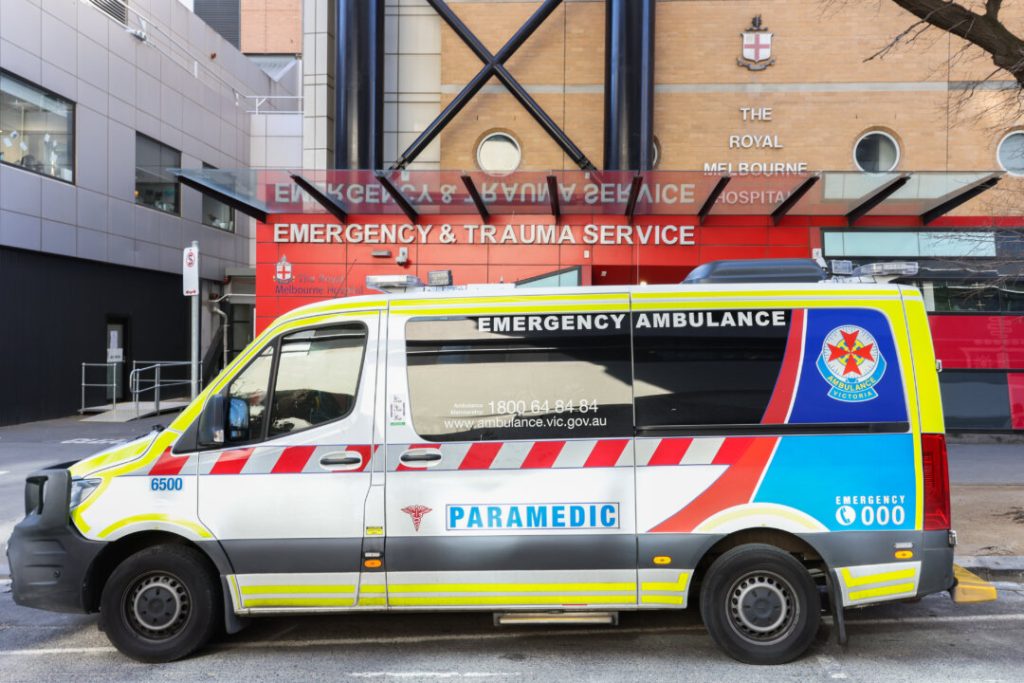






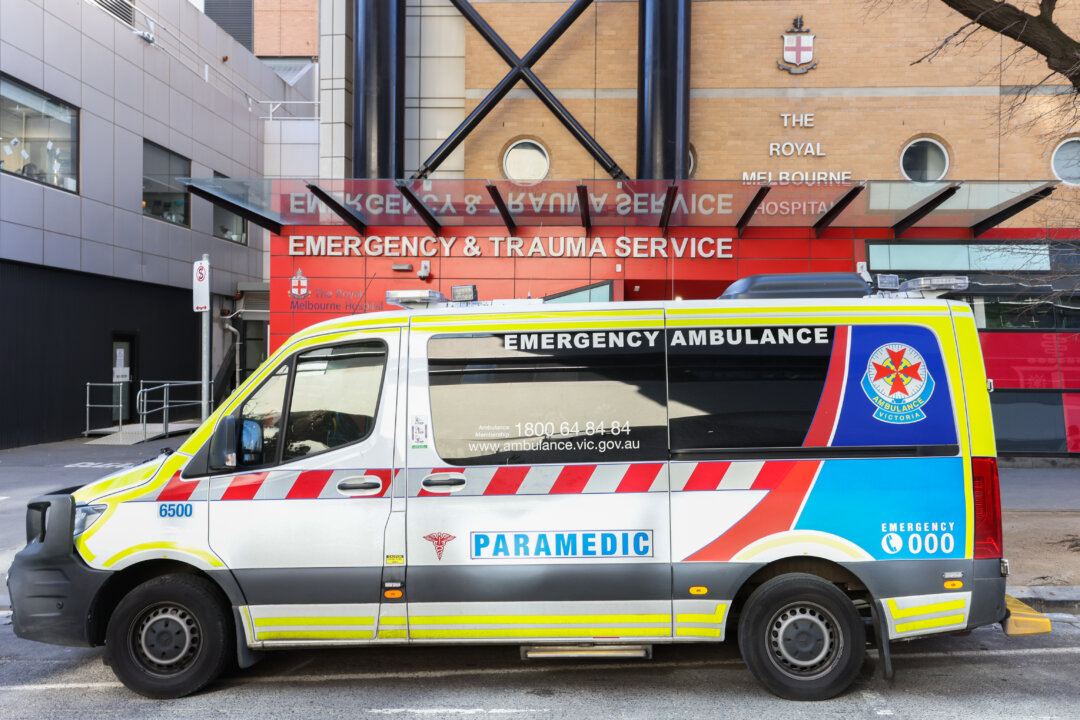

An ambulance is parked in front of the Emergency and Trauma service at the Royal Melbourne Hospital in Melbourne, Australia, on July 21, 2022. Asanka Ratnayake/Getty Images
Commentary
Like many health systems throughout the world, the Victoria’s faces significant challenges.
One is ambulance ramping—the time it takes an ambulance crew to hand over patients to hospital staff upon arrival.
This issue has been widely reported throughout Australia and particularly in Victoria for many years. However, governments of all persuasions have been unable to address it.
One major problem is that hospitals are not dealing with patients, who may not be seriously ill, fast enough.
There are many reasons for this:
Related Stories

-
Emergency departments are currently so overrun with cases that they are not diagnosing and handling patient; and
-
Hospital beds are occupied with older existing patients who should be discharged, but sadly have nowhere to go.
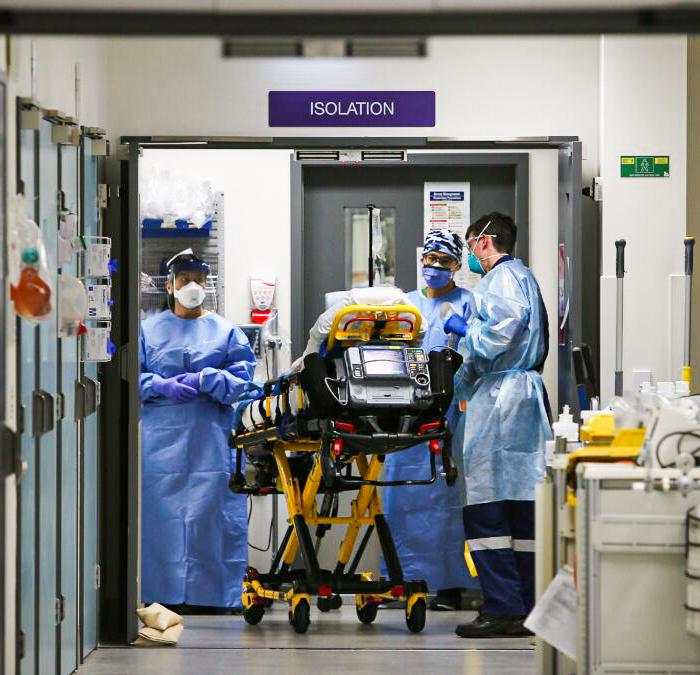
I have witnessed this myself several times in a major suburban public hospital in Melbourne, where emergency department corridors are stacked with ambulance trolleys with patients on them.
These patients were not “sick” in the conventional sense, but had sustained injuries in incidents that were not life-threatening.
For example, there was a young man with a broken leg and an older lady with a minor head injury. Both were lucid and conversing with hospital staff.
They did not need one or two ambulance paramedics standing around with them, but because they could not be admitted to the hospital, the ambulance crew remained responsible for them and were unable to leave.
Scenarios like this are repeated countless times a day in public hospitals throughout the country.
In one case, Ambulance Victoria had a uniformed member present trying to assist with triaging patients in an effort to get the numerous ambulance crews back on the road.
Delays in sending ambulance crews back out on the road can also carry big risks.
There are now many well-documented cases in which desperately ill or injured people have died after an ambulance either failed to arrive on time or did not attend at all.
In a so-called advanced Western country, this is a totally unacceptable and tragic.
Two obvious solutions come to mind.
First, for non-urgent or non-life-threatening patients, the hospital should allocate a nurse to care for the patients on trolleys whilst they wait for further medical attention.
Doing this would transfer the care and responsibility of the patient from the ambulance crew to the hospital, and free the crew to resume their duties outside the hospital.
Secondly, the government should provide a safe, dedicated facility where older patients can be discharged to. That is, a residential facility where basic food and safe shelter is provided in the short to medium term whilst a long-term solution is found.
This would free up hospital beds and address the issue of so-called “bed block,” allowing patients who arrive at the emergency department and require admission to be moved on as quickly as possible.
These two relatively simple steps should help relieve overcrowding and reduce delays in emergency departments, enabling ambulance crews to return to their on-road duties sooner.
Given that aged care and healthcare involve both state and federal governments, both levels of government must work together to address these issues and implement sensible, long-lasting solutions.
Views expressed in this article are opinions of the author and do not necessarily reflect the views of The Epoch Times.