



Hopes for Middle East Peace Grow as Israel Discusses Lebanon Ceasefire
By Steve Holland and Maayan Lubell
Summary:
- Pakistan’s army chief mediates talks in Tehran after previous negotiations stalled
- Israel cabinet meeting to discuss ceasefire in Lebanon
- US stocks hit record highs on peace optimism

A family sits next to a fire outside their tent, at a temporary encampment for displaced people, in Beirut, Lebanon, March 30.

Smoke rises behind buildings following an Israeli strike in Lebanon, near the Israel-Lebanon border, as seen from Israel, April 15, 2026.

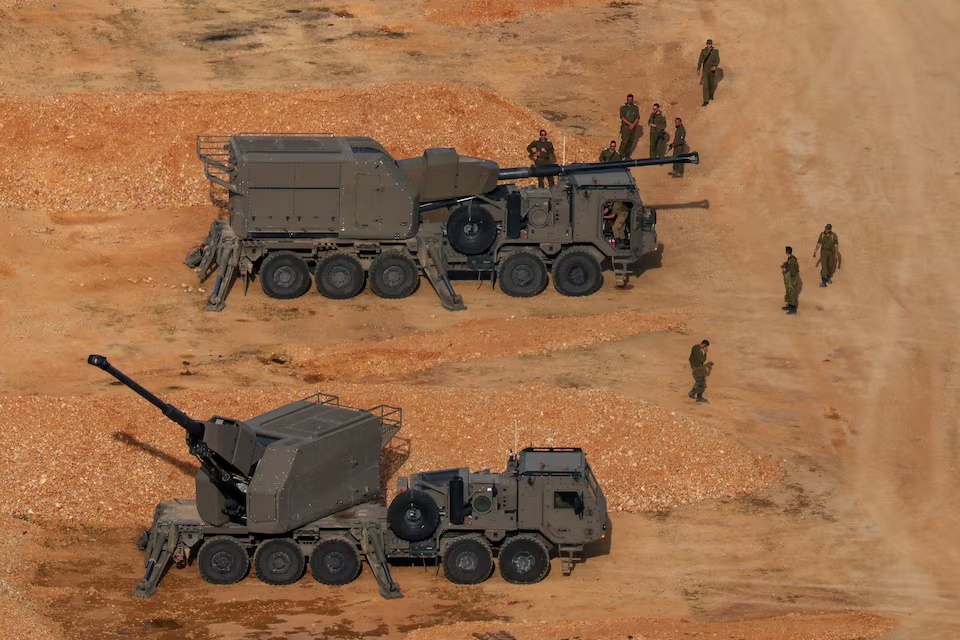
Israeli tanks operate in Lebanon, near the Israel-Lebanon border, as seen from the Israeli side of the border in northern Israel, April 14, 2026.

People on motorcycles ride along a street past banners showing portraits of students killed in a strike on a girls’ school during the U.S.-Israeli conflict with Iran, amid a ceasefire, at Tajrish Square in Tehran, Iran, April 15, 2026. REUTERS/Thaier Al-Sudani Foreign media in Iran operate under guidelines set by the Ministry of Culture and Islamic Guidance, which regulates press activity and permissions
WASHINGTON/JERUSALEM, April 16 (Reuters) – Optimism grew on Thursday that the war in the Middle East may be near an end, with a key Pakistani mediator in Tehran and the administration of President
Donald Trump talking up hopes for a deal that would open the crucial Strait of Hormuz.
Israel’s cabinet met on Wednesday to discuss a possible ceasefire in neighbouring Lebanon, a senior Israeli official said, more than six weeks into its war with Iran-backed Hezbollah. Trump said talks
between leaders of both countries would take place on Thursday, while the Financial Times reported a ceasefire could be announced soon, citing Lebanese officials.
Ending the fighting in Lebanon was a key sticking point in earlier peace talks, along with how to deal with Tehran’s nuclear ambitions.
“We feel good about the prospects of a deal,” White House press secretary Karoline Leavitt said at a news conference on Wednesday, calling conversations mediated by Pakistan “productive and ongoing.”
She denied reports that the U.S. had formally requested an extension of a two-week ceasefire agreed by the two sides on April 8.
More in-person talks had not yet been confirmed but would likely take place in Pakistan again, Leavitt said.
Pakistan’s military confirmed Munir had arrived in Tehran. A senior Iranian source told Reuters that Munir, who had mediated the last round of talks, would seek “to narrow gaps” between the two sides.
Iranian Foreign Minister Abbas Araqchi posted on X welcoming Munir and said Tehran was committed to “promoting peace and stability in the region.”
The talks last weekend broke down without an agreement to end the war, which Trump began alongside Israel on February 28, triggering Iranian attacks on Iran’s Gulf neighbours as well as reigniting the
Israel-Hezbollah conflict. Thousands of people have been killed, mostly in Iran and Lebanon, while soaring energy costs have rattled investors and policymakers around the world.
Stock markets have rallied strongly in recent days on expectations of a swift resolution to the fighting, with indexes on Wall Street hitting record highs on Wednesday as crude oil prices steadied.
“While there are hopes for de-escalation, many investors remain sceptical, given that U.S.-Iran talks have repeatedly broken down even after appearing to make progress,” said Toshitaka Tazawa, an analyst
at Fujitomi Securities.
ECONOMIC PRESSURE ON IRAN
Treasury Secretary Scott Bessent predicted that China’s purchase of Iranian oil would “pause” given a U.S. blockade on vessels calling at Iranian ports. He said the U.S. could impose secondary sanctions on
countries that purchase Iranian crude.
The U.S. Treasury had warned two Chinese banks not to process Iranian money or face sanctions, he said, without naming the banks. China previously bought more than 80% of Iran’s shipped oil.
Trump said on Wednesday he had told Chinese President Xi Jinping not to give Iran weapons, which Xi had said he wasn’t. Trump also said that China was very happy he was “permanently opening” the
Strait of Hormuz.
“I am doing it for them, also – And the World,” he wrote on social media, adding: “President Xi will give me a big, fat, hug when I get there in a few weeks.”
The war has led Iran to effectively shut the Strait – a vital artery for global crude and gas shipments – to ships other than its own, sharply reducing exports from the Gulf and leaving energy importers
scrambling for alternative supplies.
TANKERS INTERCEPTED
During the first 48 hours of the U.S. blockade on ships entering and exiting Iranian ports, no vessels have made it past U.S. forces, the U.S. military said. Additionally, nine vessels complied with direction
from U.S. forces to turn around and return toward an Iranian port or coastal area.
However, Iran’s Fars News agency said an Iranian supertanker subject to U.S. sanctions crossed the strait towards Iran’s Imam Khomeini port despite the blockade. Fars did not identify the tanker or give
further details of its voyage.
Iran’s joint military command warned it would halt trade flows in the Gulf, the Sea of Oman and the Red Sea – which connects to the Suez Canal – if the U.S. blockade continued.
Iran could consider allowing ships to sail freely through the Omani side of the strait without risk of attack as part of proposals it has offered in negotiations with the U.S., providing a deal is clinched to
prevent renewed conflict, a source briefed by Tehran said.
Trump has also threatened to escalate if the war resumes.
“We could take out every one of their bridges in one hour. We could take out every one of their power plants, electric power plants, in one hour. We don’t want to do that…so we’ll see what happens,” he told
Fox Business Network.
TALKS COMPLICATED BY NUCLEAR ISSUE
Iran’s nuclear ambitions were a key sticking point at last weekend’s talks. The U.S. proposed a 20-year suspension of all nuclear activity by Iran – an apparent concession from longstanding demands for a
permanent ban – while Tehran suggested a halt of three to five years, according to people familiar with the proposals.
Washington has also pressed for any enriched nuclear material to be removed from Iran, while Tehran has demanded that international sanctions against it be lifted.
One source involved in the talks said back-channel discussions had made progress in narrowing gaps, bringing the two sides closer to a deal that could be presented at a new round of talks.