


Iran Says it Hits U.S. Military Targets in Gulf, Buries Slain Leader Khamenei
By Elwely Elwelly, Nayera Abdallah and Idrees Ali
- Summary:
- Further attacks from U.S., Iran strain fragile detente
- Iran buries Khamenei, killed Feb. 28 at war’s outset in a U.S. strike
- Iran says it targeted US sites in Kuwait, Qatar and Bahrain
- US strikes kill 14 and injure 78, Iranian officials say
- Iran says US strike hit perimeter of nuclear power plant
DUBAI, July 9 (Reuters) – Iranian armed forces launched attacks on U.S. military infrastructure in Gulf states on Thursday following U.S. strikes on Iran’s southern coastal and eastern provinces, further eroding a three-week-old ceasefire.
Iranian media later reported multiple explosions across southern Iran, including Bushehr, where one of the country’s nuclear plants is located, along with Konarak, Choghadak and Bandar Abbas.
A U.S. official said there had been no American strikes in recent hours.
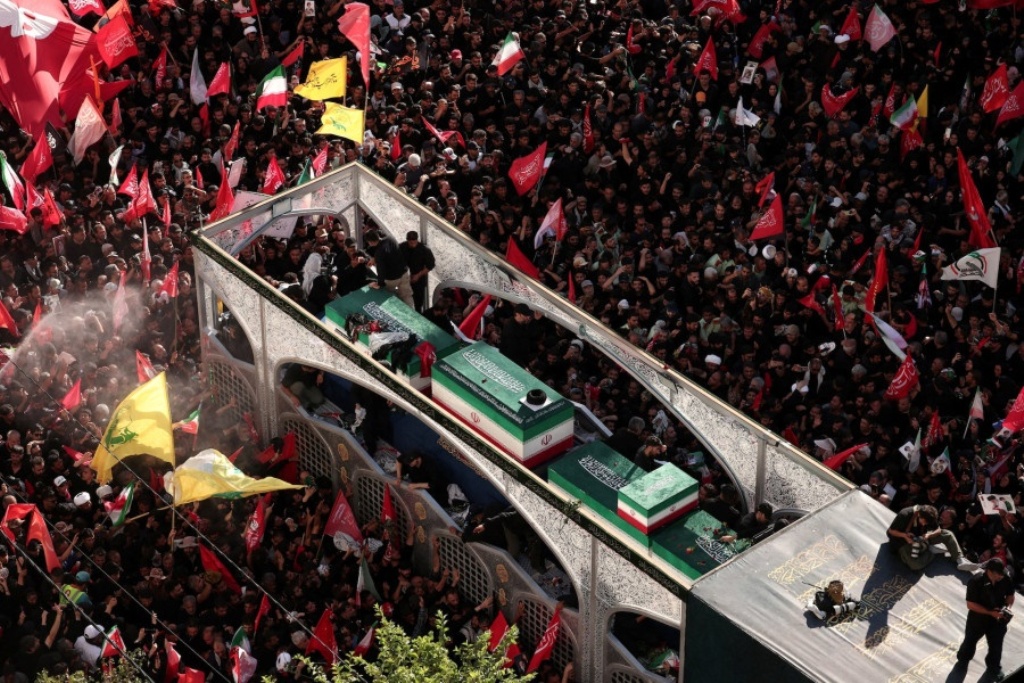
The attacks came as Iran buried its slain Supreme Leader Ayatollah Ali Khamenei at a shrine in Mashhad, capping a week of funeral processions and rallies.
Khamenei was killed in an airstrike on the first day of the war on February 28, as part of a U.S.-Israeli barrage against Iran that set off a months-long conflict killing thousands and throttling worldwide energy supplies.
Attacks on Qatari and Saudi shipping vessels earlier this week upended the ceasefire, with U.S. President Donald Trump declaring the truce “over.”
Washington was still committed to finding a resolution with Iran and “technical talks continue”, according to a second U.S. official.
Trump’s inability to end the war has frustrated the president, whose Republican Party faces midterm elections later this year amid high gas prices and voter discontent.
Khamenei’s funeral procession reached the country’s holiest shrine with a huge crowd packing the courtyard, some bearing banners denouncing the U.S. president and reading, “We Will Kill Trump.”
Iran’s Revolutionary Guards Navy said the U.S. attacks and intervention in redirecting shipping through the Strait of Hormuz were disrupting the waterway’s reopening.
The Guards said the number of vessels transiting the strait under Iranian supervision had recovered to about 50% of pre-war levels over the past two weeks, adding that permission was being granted only to ships using routes designated by Tehran.
Any further U.S. intervention will draw a “crushing response”, the Guards said.
The U.S. military said its strikes were aimed at keeping the strait open after it accused Iranian forces of attacking three tankers in the area.
The military said on Thursday the United States had helped facilitate the transit of more than 800 commercial vessels and 380 million barrels of crude oil through the strait since early May and that Iran does not control the waterway.

Vehicle transports the coffin of Iran’s late Supreme Leader Ayatollah Ali Khamenei, who was killed on February 28 in Israeli and U.S. airstrikes, and coffins of his family members, on the day of his burial, in a culmination of a mass funeral, in Mashhad, Iran, July 9, 2026.
Oil prices fell back on Thursday after spiking on concerns the fighting would disrupt global supplies.
TARGETING U.S. BASES IN GULF STATES AND JORDAN
U.S. Central Command said on Wednesday its forces had struck approximately 90 Iranian military targets, including air defence systems, coastal surveillance assets, and missile and drone storage sites.
“This is in retribution for yesterday’s bombing of ships by Iran. If it happens again, it will get much worse!” Trump wrote on his Truth Social platform.
The U.S. attacks had killed 14 people and injured 78 across five provinces on July 8 and 9, Iranian state media reported. The Fars news agency said one U.S. strike had hit a rail bridge used for trade with Russia and China.
Bushehr is home to a Russian-built nuclear power plant and a local official later told state media that a U.S. projectile had hit the perimeter area of the facility. The perimeter had already been hit several times before an April 8 ceasefire.
Iran’s army said in a statement released by state media that it had launched attacks on U.S. Patriot systems in Kuwait, an early-warning site in Qatar and a U.S. Army fuel depot in Bahrain.
Kuwait said its armed forces had engaged a cruise missile, three ballistic missiles and 10 drones in its airspace, and that one person had been injured by falling shrapnel.
Sirens also sounded in Jordan after missiles launched from Iran were detected, the state news agency reported. Eight were intercepted, with no injuries or damage reported.
The Revolutionary Guards later said Iran had fired 10 ballistic missiles at Jordan’s Azraq military base, used by U.S. forces, and also at a U.S. military control center in the Middle East, without elaborating.
Qatar, which hosts the largest U.S. base in the region and has often mediated between Washington and its adversaries including Tehran, condemned attacks on commercial shipping but also called for a return to diplomacy.
The foreign ministers of Turkey and Oman also stressed the need to avoid further military escalation in separate calls with their Iranian counterpart, Abbas Araqchi.
In a call with the army chief of Pakistan, which has also mediated in the conflict, Araqchi condemned what he called U.S. “warmongering policies”.
The Strait of Hormuz handled about a fifth of global oil supplies before the war. Tehran has since largely taken control of the strait, forcing a stalemate in its confrontation with the world’s most powerful military.
“The Strait of Hormuz will be reopened only under Iranian arrangements, not through U.S. threats,” Iran’s top negotiator, Mohammad Baqer Qalibaf, wrote on X.