











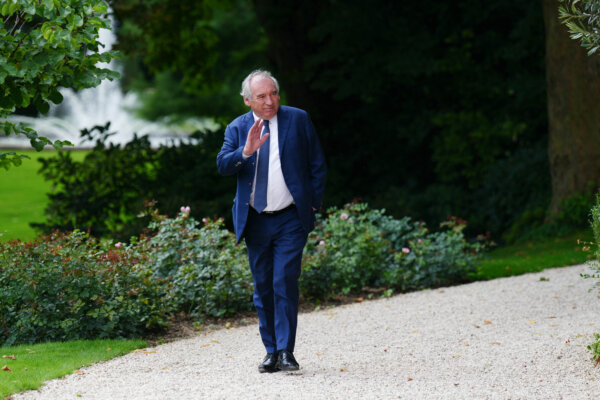
François Bayrou will have to navigate France’s choppy political waters amidst division and billions of euros in spending cuts and tax increases.
Centrist politician Francois Bayrou has been announced as France’s new prime minister.
On Dec. 5, French lawmakers from all sides of the political spectrum voted to remove conservative Michel Barnier from the powerful post, signaling deepening divisions within the French parliament.
On Friday, President Emmanuel Macron named François Bayrou—a French centrist and a longstanding ally—to the role of prime minister.
Macron has vowed to remain in the Elysee Palace for the duration of his term, which runs until mid-2027. Before then, he cannot be ousted by Parliament, although opposition on both his left and right flanks are already calling for his resignation.
Macron is being pulled in multiple directions, caught between a left-wing coalition that includes his own party, La France Insoumise, the Socialist Party, the Ecologists, and the French Communist Party, and the right-wing National Rally.
Bayrou will have to navigate the uncertainty around the deeply divided parliament has also made it increasingly difficult for the government to pass the 2025 budget.
The country’s debt is projected to soar to above 3 trillion euros ($3.17 trillion) by 2025, with public debt hovering at around 110 percent of GDP.
This is a developing story; updates will follow.

